Utilization Rate: How to Calculate It and What a Good One Looks Like for a Solo Business
How to calculate your utilization rate as a solo professional, why 100 percent is not the goal, and what to change when your billable share starts slipping.
Utilization rate tells you what share of your working time turns into billable work. It is one of the most useful numbers a solo business can watch, because it connects how busy you feel to how much you actually earn. It is also easy to misread. A high number is not always good, and a low number is not always a problem. This guide walks through the formula, some worked examples, and how to decide what a healthy rate looks like for your own practice.
In this guide
- 01What is utilization rate?
- 02How do you calculate utilization rate?
- 03What do worked utilization examples look like?
- 04Why is 100 percent utilization impossible for a solo business?
- 05What is a good utilization rate for a freelancer or consultant?
- 06What should you do when your utilization rate is low?
- 07How do you track utilization week to week?
What is utilization rate?
Utilization rate is the percentage of your available working hours that you spend on billable client work. If you worked forty hours this week and billed twenty-eight of them, your utilization was seventy percent. The other thirty percent went to everything that keeps the business running: sales, admin, invoicing, learning, and the small tasks that never fit neatly under a client.
Agencies and consulting firms use utilization to plan staffing. For a solo professional it does a different job. It shows you how much of your week is actually producing revenue, and it makes the hidden cost of running a business visible. If you have ever wondered why a full week produced a thin invoice, utilization is usually the answer. It turns a vague feeling of being busy into a number you can track and improve.
How do you calculate utilization rate?
The formula is billable hours divided by available hours, multiplied by one hundred. Billable hours are the hours you can invoice or that count toward a client agreement. Available hours are the hours you intend to work in the period, not every hour in the week. Choose a period, usually a week or a month, and use the same definitions every time.
The tricky part is the denominator. Some people use the hours they actually worked. Others use a fixed capacity, such as forty hours a week. Using actual hours tells you how efficiently you used the time you put in. Using fixed capacity tells you how close you are to a sustainable full load. Both are useful. Pick one as your main number and be clear about which one you are looking at.
You also need clean data. If short tasks go untracked or non-billable work is never logged, the numbers will be wrong in both directions. Utilization is only as good as the time records underneath it. Before you trust the percentage, make sure every client session is logged and every internal task has somewhere to go, even if that is a single bucket called admin.
- Utilization rate = billable hours / available hours x 100
- Billable hours: time you invoice or that counts toward a client agreement.
- Available hours: either hours actually worked or a fixed weekly capacity. Pick one and stay consistent.
What do worked utilization examples look like?
The table below shows a few illustrative scenarios. These are made-up examples to show how the math works, not benchmarks. Each one uses hours actually worked as the denominator. Divide the billable column by the hours column and you get the percentage on the right. Running the same calculation on your own last four weeks is the fastest way to see where you actually sit, and it usually takes only a few minutes once your time is tracked.
Notice that the highest utilization in the table is not necessarily the best week. A week at ninety percent may mean no time for sales, which can turn into an empty pipeline a month later. A week at fifty percent may be fine if it included a deliberate push on marketing that brings in new work. The number tells you what happened. Whether it was good depends on what you intended for that week.
| Example scenario | Hours worked | Billable hours | Utilization |
|---|---|---|---|
| Example A: steady client week | 40 | 30 | 75% |
| Example B: heavy sales week | 40 | 20 | 50% |
| Example C: deadline crunch | 50 | 45 | 90% |
| Example D: admin-heavy month end | 36 | 22 | 61% |
| Example E: part-time practice | 25 | 18 | 72% |
Why is 100 percent utilization impossible for a solo business?
When you work alone, nobody else handles the parts of the business that are not client work. You find clients, write proposals, send invoices, chase payments, update your tools, and keep your skills current. None of that is billable, and none of it is optional. A business at one hundred percent utilization is a business that has stopped doing all of those things.
There is also a practical ceiling from the work itself. Switching between clients takes time. Calls run over. Some tasks are partly billable and you choose not to charge for all of it. Even on a very focused week, a slice of your time will go to things you cannot reasonably invoice. Your energy matters too. Billable work is often the most demanding work you do, and few people can sustain it for every working hour.
Treat sustained utilization near the top of your range as a warning, not a win. It often means sales and admin are being postponed, and that debt comes due later as a gap in work or a pile of overdue paperwork. A short burst during a deadline is normal. Months of it usually end with a quiet period you did not plan for, or with burnout.
What is a good utilization rate for a freelancer or consultant?
There is no single right number, and you should be wary of anyone who gives you one without knowing your business. A good rate is one that covers your income target at your current prices while leaving enough time to keep the pipeline full and the business running. That depends on your rate, your sales cycle, and how much admin your type of work creates.
The practical way to find your number is to work backward. Start with the income you need, divide by your effective hourly rate to get the billable hours required, then compare that to the hours you are willing to work. The ratio is your target utilization. If the target looks unrealistic, the fix is usually price, not more hours. For example, if you need 1,200 billable hours a year and plan to work 1,600, your target is seventy-five percent.
Then track your actual utilization for a few months. Your own history is a better guide than any general figure, because it reflects your clients, your work, and your habits. After a quarter you will know your normal range, which weeks fall outside it, and why. That range becomes the baseline you judge future weeks against, and it is far more useful than a number borrowed from a firm with a sales team and an office manager.
What should you do when your utilization rate is low?
Start by finding out where the non-billable time went. Look at your non-billable entries for the period and group them by type. A low rate caused by a deliberate sales push is very different from one caused by slow admin or unbilled client requests. The second kind is a leak you can fix. Spend ten minutes sorting the non-billable hours into a few buckets, such as sales, admin, learning, and unbilled client work, and the biggest one will usually be obvious.
Common causes include client work that you did but did not track, scope creep you absorbed without billing, and admin tasks that take longer than they should. Each has a different fix: a tighter capture habit, a scope conversation, or a better process for invoicing and email. The first is the most common and the cheapest to solve. Many people find that their utilization was never low at all. They were doing the client work and simply not recording it.
If the cause is simply not enough client work, utilization is telling you about your pipeline. That is useful early warning. Act on it while you still have current work paying the bills, not after the last project ends. Shift a few hours a week into outreach, follow up with past clients, and ask current clients whether anything else is coming. A dip caught early is much easier to recover from than a gap discovered late.
- Check for untracked client work first.
- Look for out-of-scope requests you absorbed.
- Measure how long invoicing and email really take.
- If demand is the issue, move time into sales now.
How do you track utilization week to week?
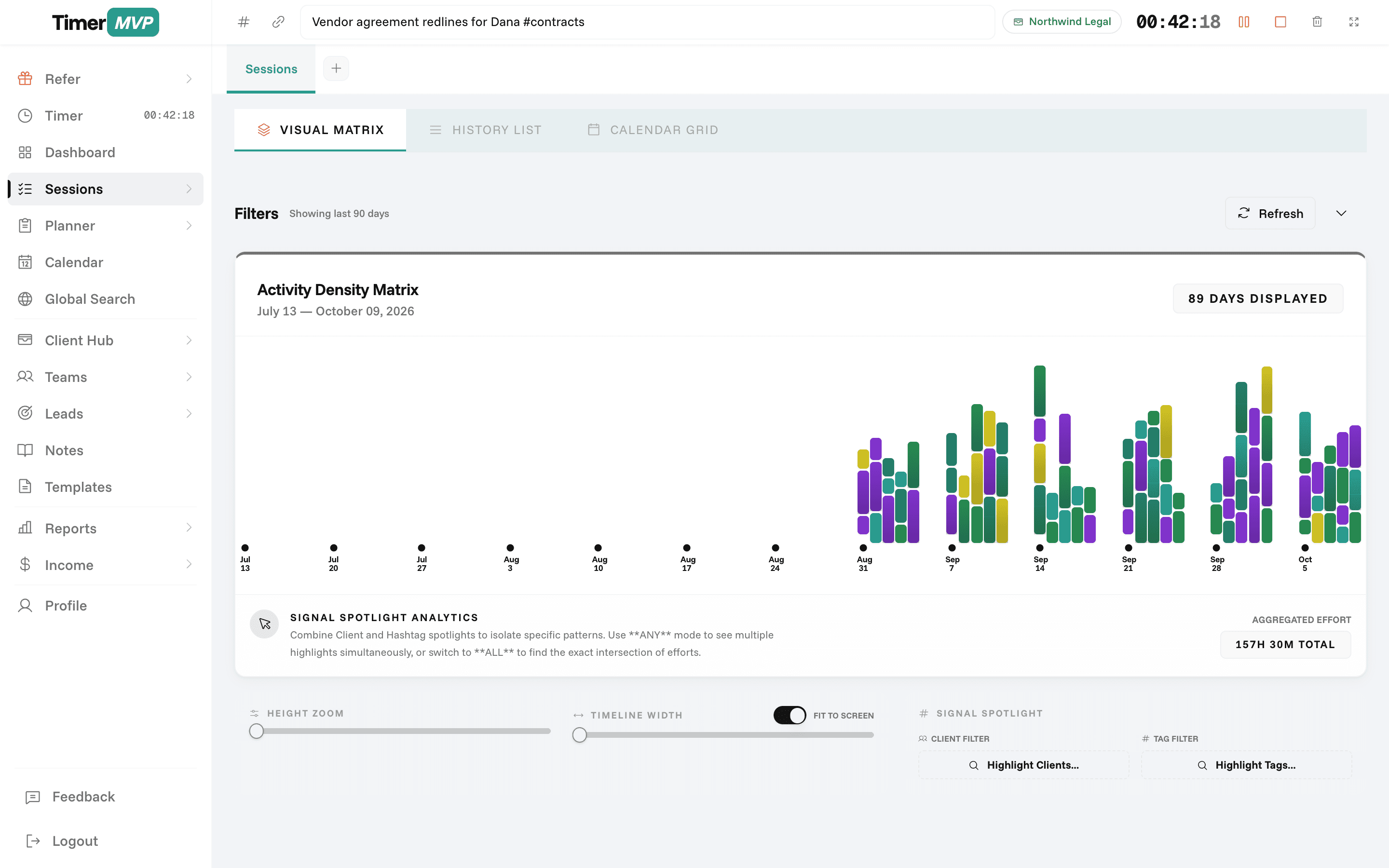
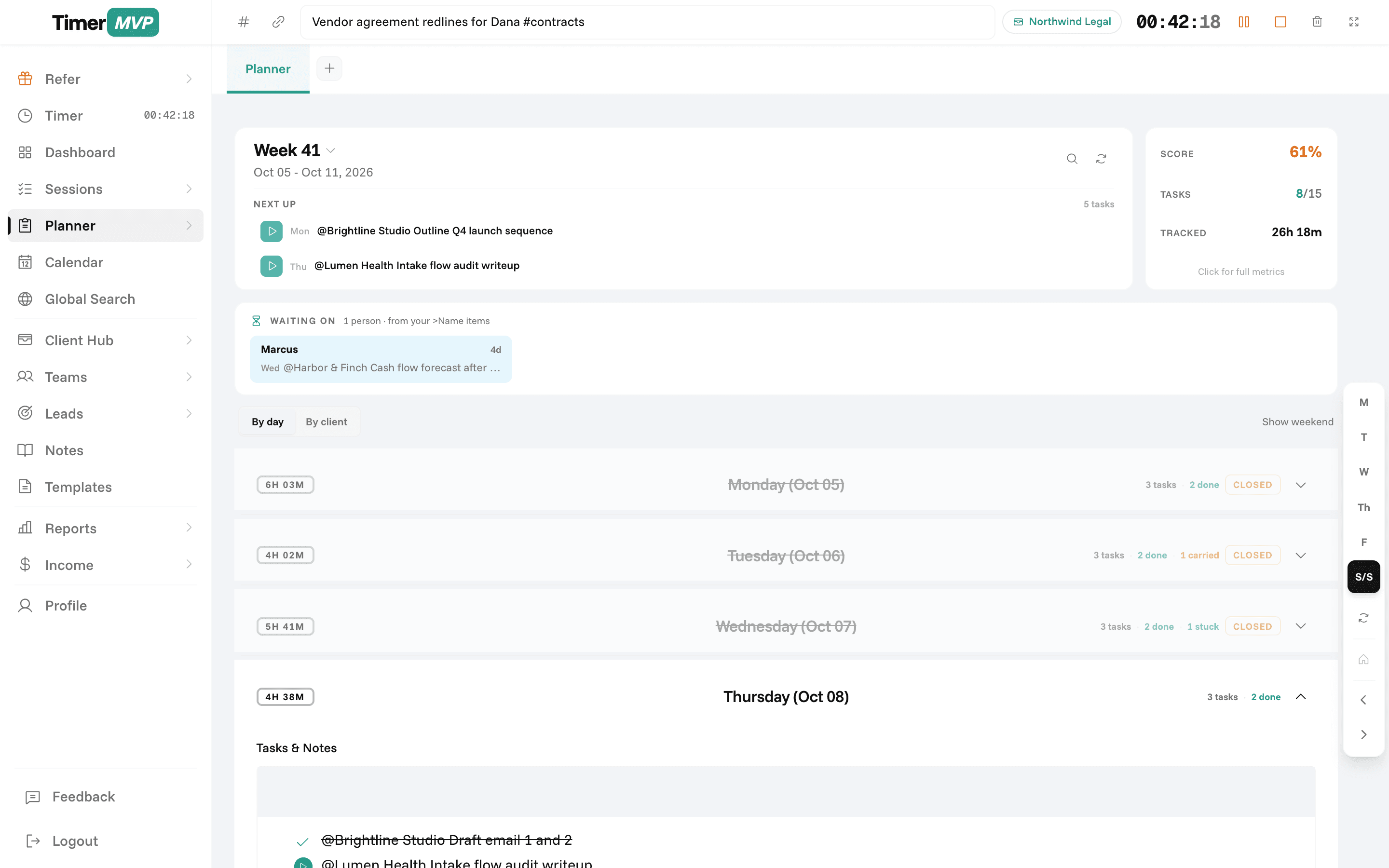
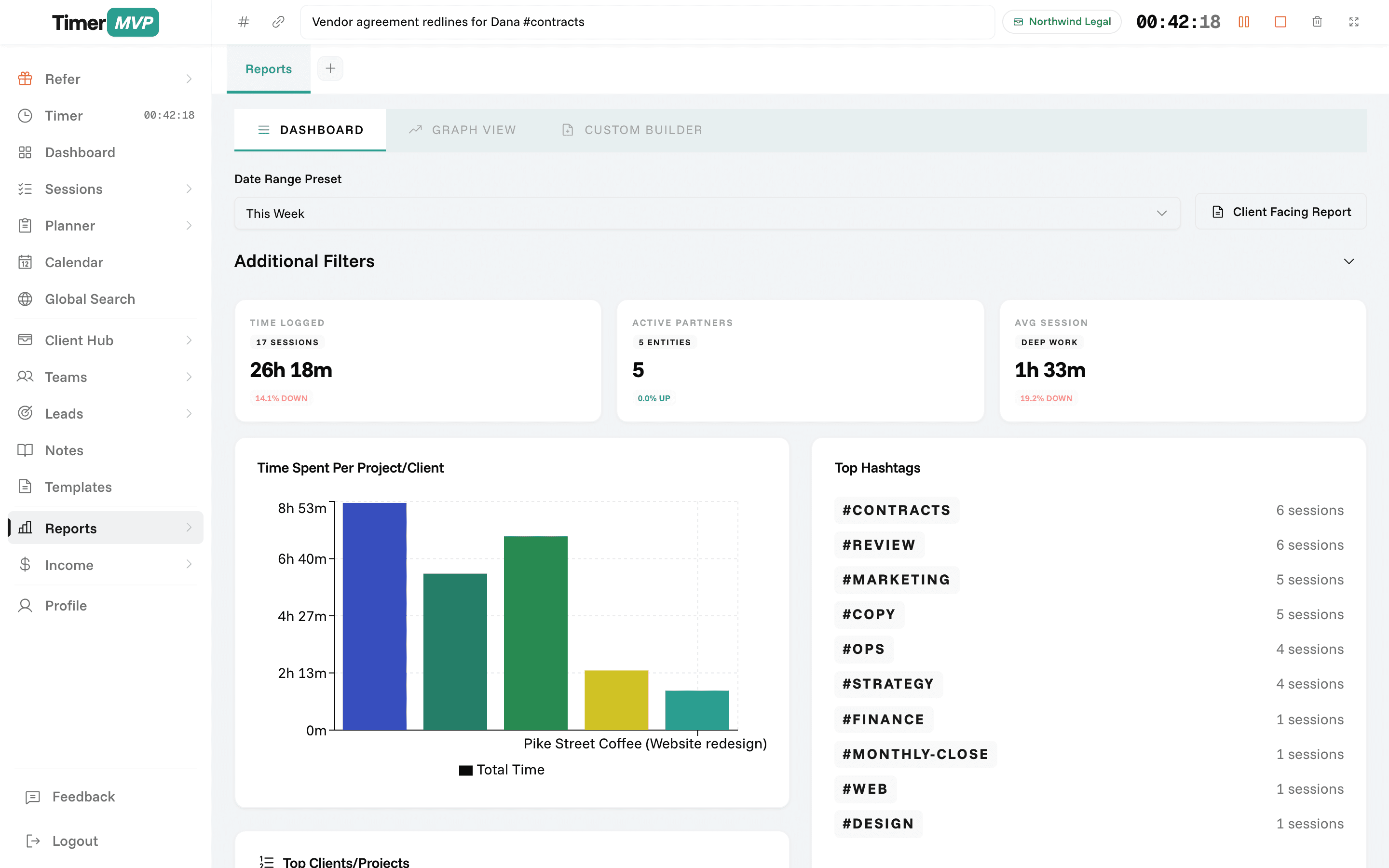
Utilization needs two things: every hour recorded, and every hour labeled as billable or not. If your time tracker ties each session to a client and lets you mark internal work separately, the calculation becomes automatic. TimerMVP reports show billable and total hours by week and by client, so you can see the ratio without building a spreadsheet. The important part is the habit of labeling, not the tool. Any system works if every hour has a client or an internal category attached.
Look at the trend more than any single week. One heavy sales week will drag the number down and that is fine. A slow decline over two months is the signal worth acting on. Pair utilization with your effective hourly rate so you can see both how much of your time is billable and what that time is actually worth.