Effective Hourly Rate: Why Your Real Rate Is Lower Than Your Quoted Rate
Your quoted rate is not what you earn per hour. Learn how to calculate your effective hourly rate per client, where the gap comes from, and how to close it.
Your quoted rate is the number on your proposal. Your effective hourly rate is what you actually earn for each hour a client takes from you. The two are almost never the same, and the gap is usually larger than people expect. Unbilled email, extra revision rounds, and fixed fees that ran long all pull the real number down. This guide shows you how to calculate your effective rate overall and per client, and what to do about the client at the bottom of the list.
In this guide
- 01What is the difference between a quoted rate and an effective hourly rate?
- 02How do you calculate your effective hourly rate?
- 03Where does unbilled time come from?
- 04What does an effective hourly rate example look like?
- 05How do retainers and fixed fees affect your effective rate?
- 06How do you compare effective hourly rates across clients?
- 07What should you do about your lowest effective rate client?
What is the difference between a quoted rate and an effective hourly rate?
Your quoted rate is what you tell a client an hour of your time costs. It is a price. Your effective hourly rate is a result. You calculate it by dividing what a client actually paid you by every hour you actually spent on that client, billed or not. If you quote a rate and bill every minute you work, the two numbers match. In practice that almost never happens.
The gap exists because client work produces time that does not make it onto an invoice. Some of it you choose not to bill. Some of it you forget. Some of it is built into a fixed price that turned out to be too low. Your quoted rate tells you what you hoped to earn. Your effective rate tells you what you did earn, and it is the number that should drive your pricing decisions.
How do you calculate your effective hourly rate?
Take the revenue you received from a client over a period and divide it by the total hours you spent on that client in the same period. Total hours means everything: billed work, unbilled calls, email, revisions you absorbed, and project management. If you leave out the unbilled time, you are just recalculating your quoted rate and learning nothing new.
Use a long enough period to smooth out the noise. A single week can be distorted by an invoice that landed early or a project that has not been paid yet. A month or a quarter gives a more honest picture. Match the revenue to the work it pays for as closely as you can, especially for project fees paid in installments.
You can also calculate a business-wide effective rate by dividing total revenue by total working hours, including sales and admin. That number is usually the lowest of all, and it is the one that tells you what your time is really worth across the whole business. Compare it to the rate you would need to hit your income goal. If the business-wide number falls short, raising your quoted rate alone may not fix it. You may also need to cut unbilled work or the admin that surrounds it.
- Per client: revenue from that client / all hours spent on that client.
- Whole business: total revenue / total working hours, including admin and sales.
- Use a month or a quarter, not a single week.
Where does unbilled time come from?
Most unbilled time falls into a handful of categories. Email and messages are the biggest for many people, because each one feels too small to charge for. Short calls that were not on the calendar come next. Then there are revisions beyond what was agreed, which you absorb to keep the client happy, and the internal coordination that comes with any project: updating a task list, chasing a file, reading back through a thread.
None of this is wrong in itself. Some goodwill is a reasonable cost of keeping a client. The problem is when it is invisible. If you never track this time, you cannot tell the difference between a client who costs you an extra hour a month and one who costs you an extra ten. Both feel like normal client work while it is happening.
The fix is to track all client time, then decide what to bill. Tracking does not commit you to charging for everything. It just gives you an accurate picture so that the decision is yours rather than something that happens by default. A short note on each entry, such as unbilled or goodwill, keeps those hours visible in your reports without putting them on the invoice. Over time you will see exactly how much goodwill each client receives.
What does an effective hourly rate example look like?
The table below is an illustrative example for a single month with three clients. The figures are invented to show the calculation, not drawn from real businesses. Each client was priced with the same $120 target rate in mind, whether the fee was hourly, a retainer, or a fixed project price. The difference comes entirely from how many hours each one actually consumed. Divide the revenue column by the hours column to get the effective rate on the right.
In this example, Client A is billed hourly and almost every hour is captured, so the effective rate stays close to the quoted one. Client B is on a retainer that has quietly grown in scope. Client C is a fixed-fee project that ran well over its estimate. On paper all three pay well. Measured by the hour, one of them pays far less than the others, and you would never see it without tracking every hour.
| Example client | Pricing | Revenue | Hours spent | Effective rate |
|---|---|---|---|---|
| Example Client A | Hourly at $120 | $4,800 | 42 | $114 |
| Example Client B | Retainer | $3,000 | 35 | $86 |
| Example Client C | Fixed fee | $6,000 | 68 | $88 |
| All three | Mixed | $13,800 | 145 | $95 |
How do retainers and fixed fees affect your effective rate?
Retainers and fixed fees move the risk of time onto you. The client pays a known amount, and you deliver the work however long it takes. That can be a good deal for you when you are efficient and the scope is clear. Many professionals earn more per hour on fixed fees than on hourly work, because they are rewarded for speed rather than paid less for it.
The same structure can work against you. A retainer that started at ten hours a month can drift to fifteen without anyone discussing it. A fixed-fee project can grow through small requests that each seem reasonable. Because the invoice does not change, nothing prompts you to notice. The only signal is the hours, and only if you track them. By the time the work feels heavy, the drift has usually been going on for months.
For any non-hourly work, record your time exactly as you would for hourly work. Then calculate the effective rate at the end of each month or project. It turns a fixed price from a guess into something you can measure and adjust. Over a few projects you will learn which kinds of work you consistently underprice and which you price well. That history is the best input you have for the next proposal.
How do you compare effective hourly rates across clients?
Once you have a few months of data, rank your clients by effective rate. The list is often surprising. A client you think of as your best may be near the bottom because of heavy communication. A small client you rarely think about may be near the top because the work is clear and the approvals are fast. The ranking replaces impressions with numbers, which is exactly what you need before any pricing conversation.
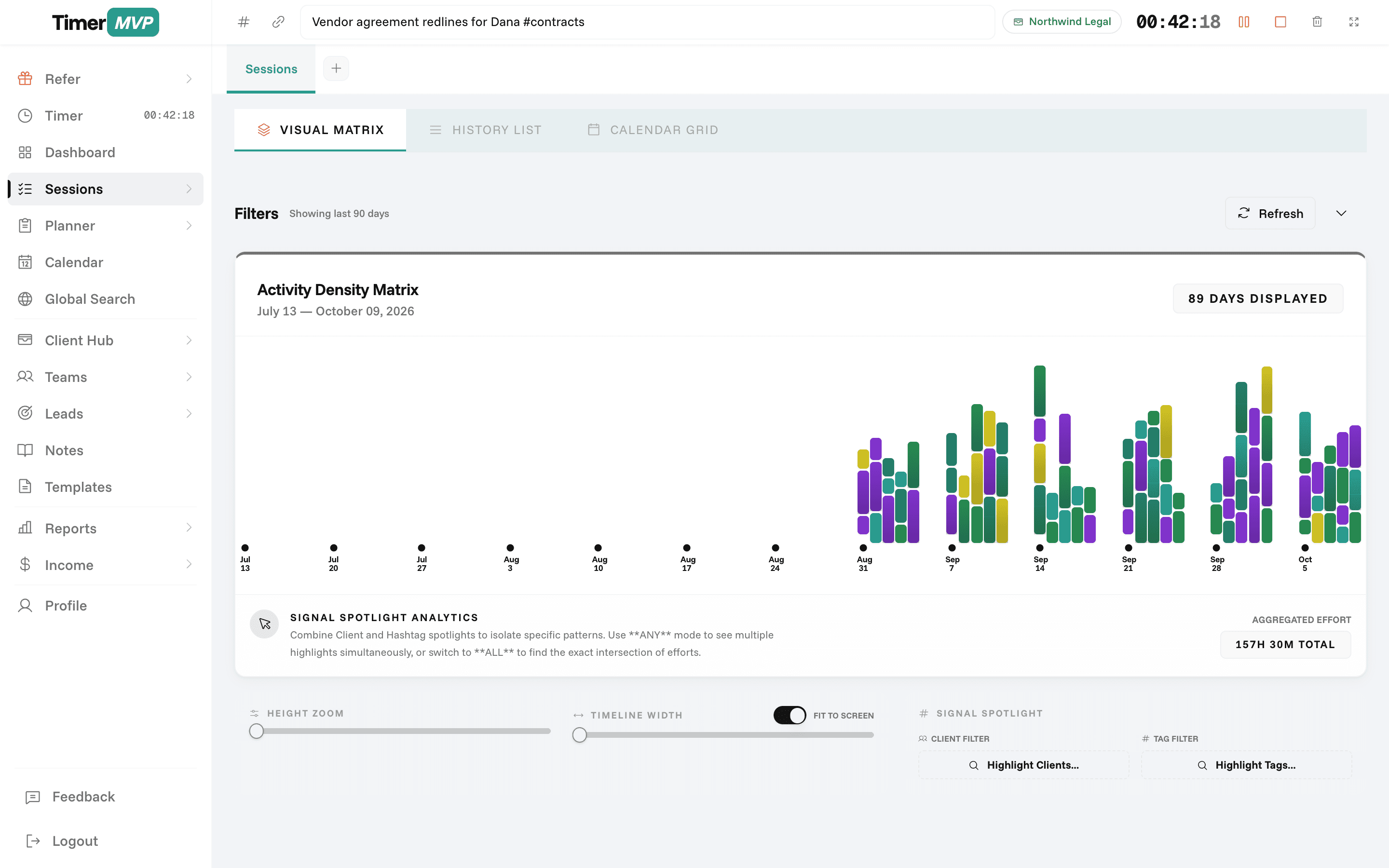
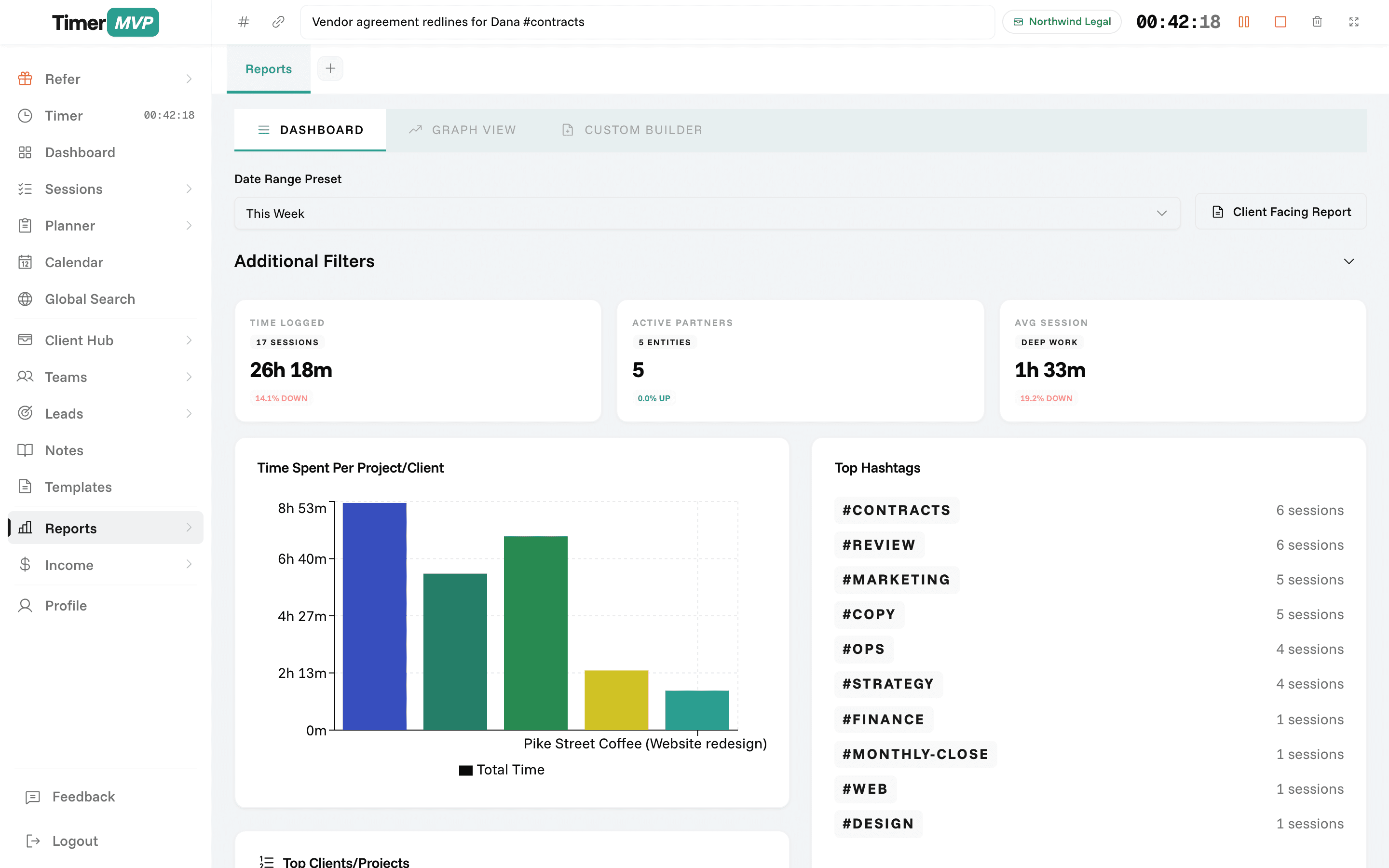
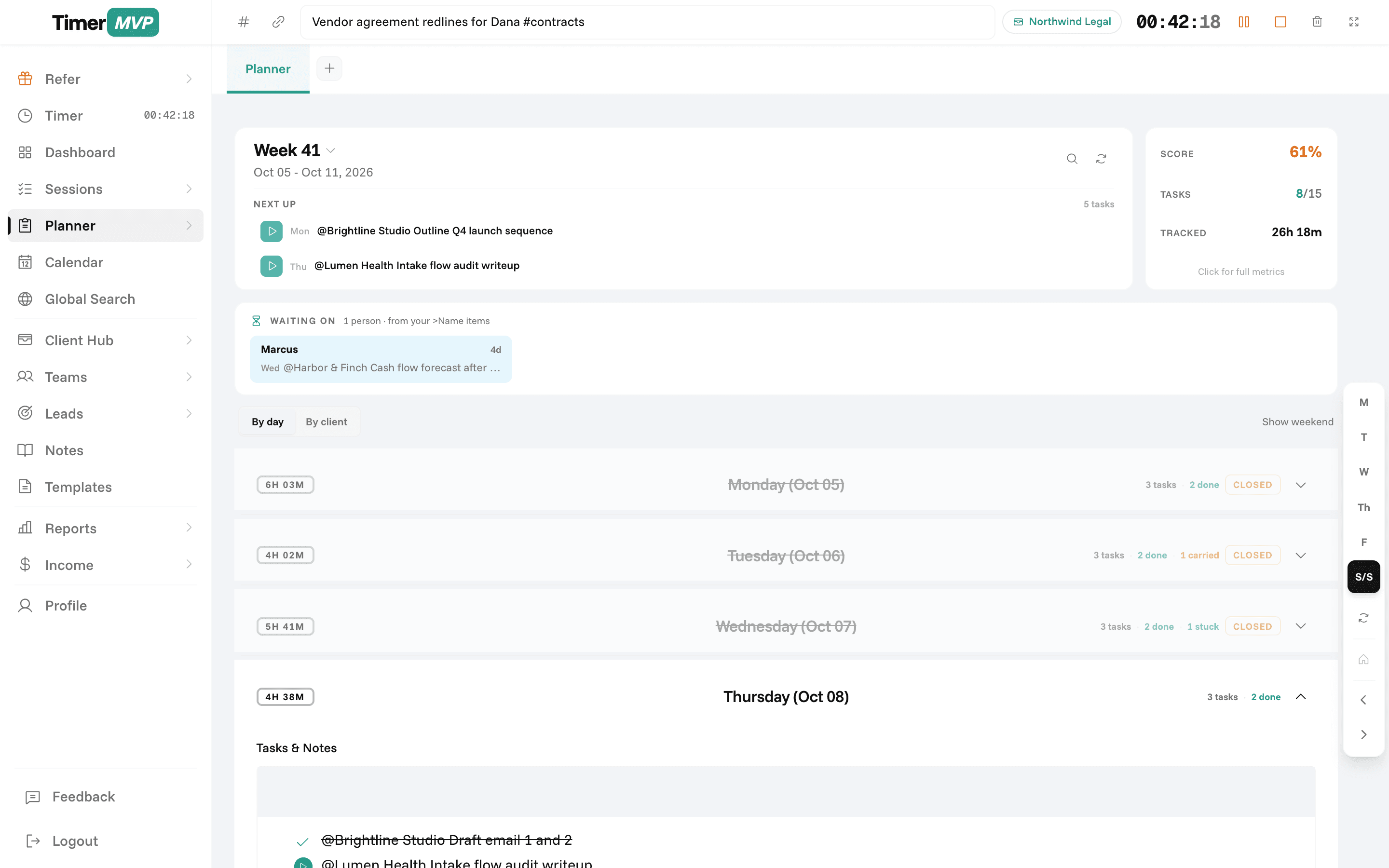
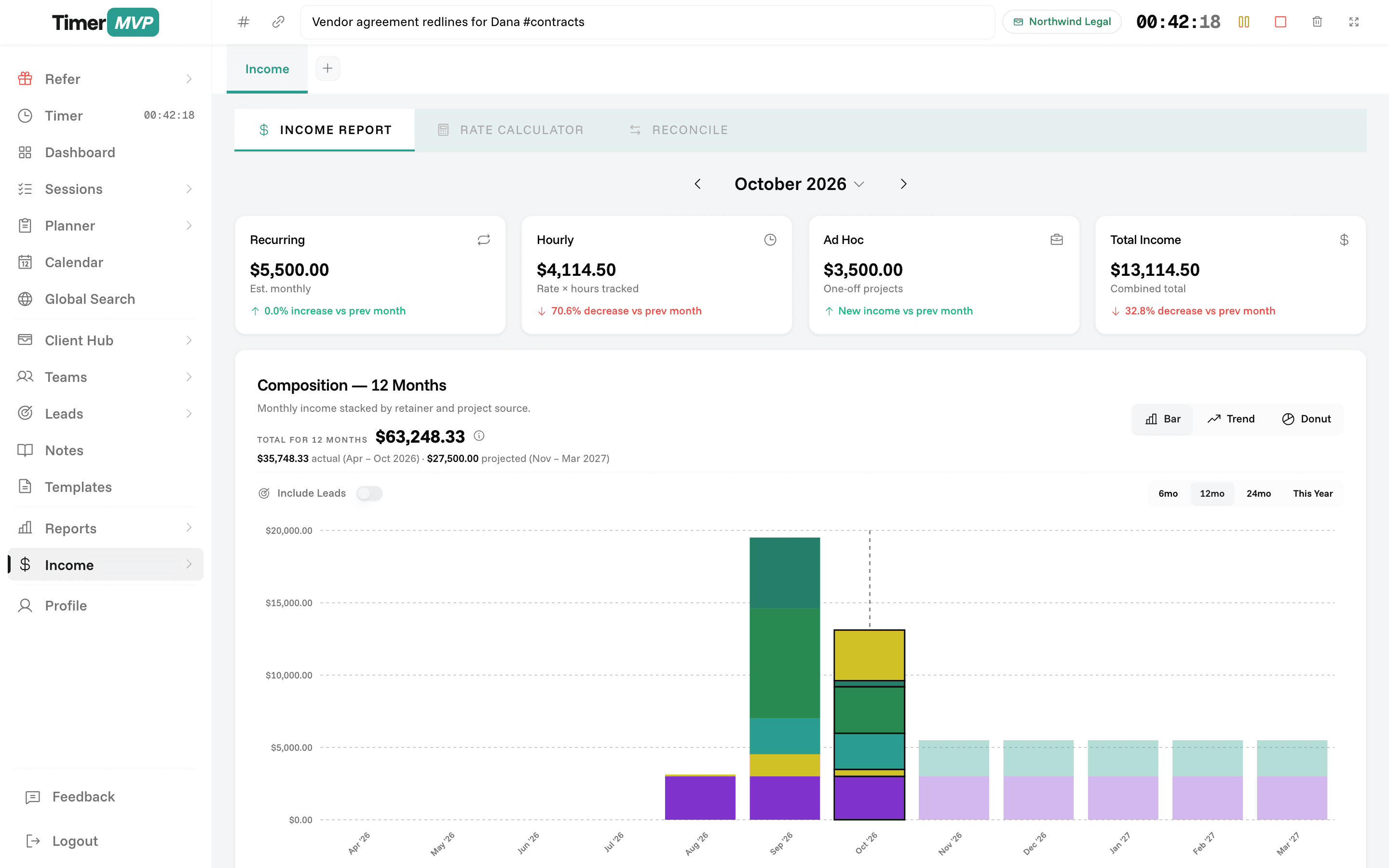
Look at the ranking alongside revenue. A low effective rate on a client who brings in a small amount is an annoyance. A low rate on a client who makes up a large share of your income is a strategic problem. TimerMVP shows earnings and hours side by side for each client, using the rate that applied when each session was recorded, so a rate change does not rewrite past months.
Watch the trend too. A client whose effective rate is slowly falling is usually experiencing scope creep. Catching that early lets you have a calm conversation instead of a frustrated one. A month-over-month view of each client's effective rate is enough. What matters is one line per client and the habit of checking it during the same review where you look at your hours.
What should you do about your lowest effective rate client?
Start by finding out why the rate is low. Look at the time entries and notes for that client and group them by type of work. Is it revisions, communication, meetings, or a specific deliverable that always takes longer than planned? The cause decides the fix, and guessing at it usually leads to the wrong conversation. Good notes on your time entries make this step quick, because the answer is already written down.
If the issue is scope, have a scope conversation. Show the client what was agreed and what has been delivered, and offer options: a higher fee, a smaller scope, or a change order for the extra work. If the issue is process, such as slow approvals or scattered feedback, propose a better process. If the client is unwilling to change anything, consider whether the relationship is worth keeping at that rate.
Sometimes the right answer is to keep the client anyway, perhaps because they provide stability or valuable referrals. That is a legitimate choice. The point is to make it deliberately, with the real number in front of you. If you keep a low-rate client by choice, set a limit on how much unbilled time you will give them, and check against it each month. A known trade-off is a business decision. An unknown one is a slow leak.
- Identify the type of work that is eating the hours.
- Raise the fee, reduce the scope, or add a change order.
- Fix process problems like slow approvals.
- Decide deliberately whether to keep the client.