How to Track Billable Hours: A Practical Guide for Freelancers and Consultants
A practical guide to tracking billable hours: what counts, which increments to use, how to write notes that hold up, and a weekly review that keeps you honest.
Billable hours are the raw material of an independent practice. If you bill by the hour, they are your revenue. If you bill by project or retainer, they are the only honest way to know whether a price was right. Most people do not lose money because they charge too little per hour. They lose it because hours slip through without being recorded. This guide covers what to count, how to capture it, and how to review it so the number on your invoice matches the work you did.
In this guide
- 01What counts as a billable hour?
- 02What billing increment should you use?
- 03Should you track time as you go or reconstruct it later?
- 04How do you write time entry notes that survive a client question?
- 05How should you review your billable hours each week?
- 06What are the most common billable hour tracking mistakes?
- 07How do you turn tracked hours into an invoice?
What counts as a billable hour?
A billable hour is time you spend on work a client has agreed to pay for. That sounds simple until you look at a real week. Client calls are billable. Drafting, building, research, and revisions for a client usually are. Writing your own proposal to win the work usually is not. The grey area sits in between: the email thread that turns into a twenty-minute problem, or the time spent learning a new client's systems.
The answer is not a universal rule. It is whatever your agreement says, applied consistently. Before you start tracking, write down your own policy in a few lines. Decide whether you bill for client email, travel, onboarding, internal meetings about a client, and fixing your own mistakes. Once the policy exists, every entry becomes a quick yes or no instead of a negotiation with yourself at invoice time.
Track the non-billable time too. You do not invoice it, but you need it. Admin, sales, and learning are real hours in your week, and they explain why a forty-hour week rarely produces forty billable hours. Without them, your reports show a business that looks underworked when it is actually overloaded. Logging them takes the same one click as client work, and it gives you the full picture of where the week went.
- Usually billable: client calls and meetings, focused client work, revisions within scope, research for a specific deliverable.
- Depends on your agreement: client email, travel, onboarding, out-of-scope requests, rush work.
- Usually not billable: proposals, invoicing, bookkeeping, your own marketing, general learning.
What billing increment should you use?
An increment is the smallest unit you bill. Common choices are one minute, six minutes, fifteen minutes, and thirty minutes. Six-minute increments split an hour into tenths, which makes the math clean and is standard in legal billing. Fifteen-minute increments are common among consultants and agencies. Some freelancers bill exact minutes and round only the invoice total. What matters is that the client knows which one you use before the first invoice arrives.
The right increment is the one your client expects and your contract states. Larger increments round small tasks up, which can feel unfair to a client if you bill a quarter hour for a two-minute reply. Smaller increments are more precise but produce longer invoices. Whatever you pick, apply it the same way every time, and decide in advance whether you round each entry or round the daily total.
Keep the raw time separate from the billed time. Record what actually happened, to the minute, and apply rounding when you invoice. That way your data stays accurate for your own analysis, and you can change your rounding policy later without rewriting history. It also protects you if a client ever asks to see the unrounded record, because you can show exactly what happened and exactly how the rounding was applied.
Should you track time as you go or reconstruct it later?
Track as you go. Reconstructing a day from memory, calendar entries, and sent email always loses time. The losses come from the small things: a call that ran long, a quick fix between meetings, the fifteen minutes you spent re-reading a brief before starting. Each one feels too small to matter, and together they add up to hours each week.
Real-time tracking means starting a timer when you begin a piece of work and stopping it when you switch. It takes a second, and it builds a habit that pays for itself quickly. In TimerMVP that is one click to start against a client and one to stop, with a note field right there. The point is not the tool. The point is that the record is created while the work happens, not after.
If you do have to reconstruct, do it the same day. Use your calendar, your sent folder, and your file history as evidence. Write down what you know, mark estimates as estimates, and do not bill for time you cannot account for. Then treat the gap as a signal. A rebuilt day usually points to one moment, like back-to-back calls, where the habit broke down.
How do you write time entry notes that survive a client question?
Sooner or later a client will ask what an hour was for. The note on that entry is your answer. A good note names the deliverable, the action, and anything that explains the time. Compare a note that says work on site with one that says rebuilt checkout form validation after the payment provider changed its field rules. The second one answers the question before it is asked.
Write notes in plain language your client would understand. Avoid internal shorthand. Name the thing you produced or the decision you made, not just the activity. If the time ran longer than expected, say why in one line. That single sentence is often the difference between a paid invoice and a write-off. Clients rarely object to time they understand. They object to time that looks unexplained.
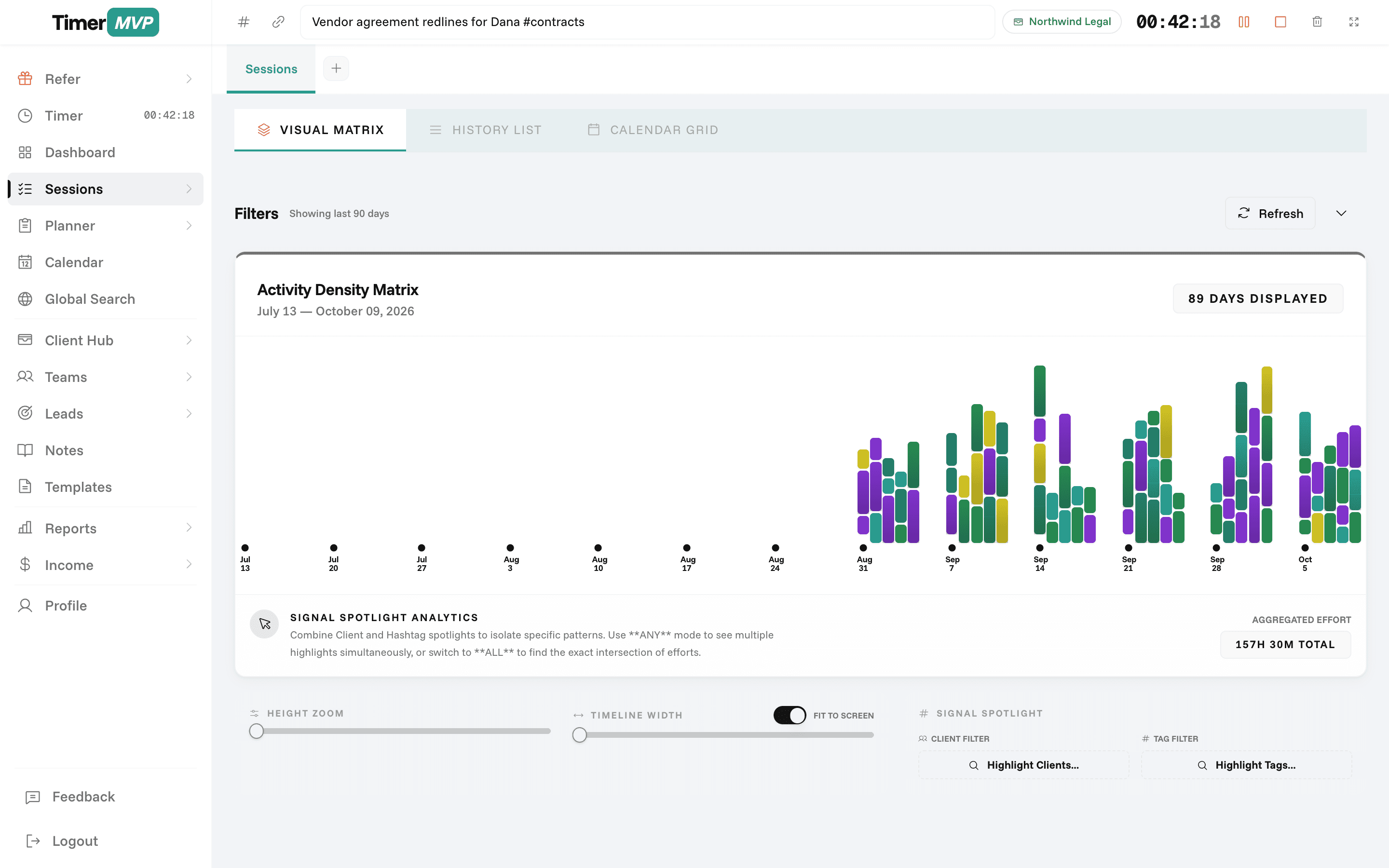
Notes also help you. Three months from now, when you are pricing a similar project, a history of specific notes tells you how long each kind of task really takes. Tagging entries by type of work, such as revisions or meetings, makes that history searchable. You can pull every revision entry for a client and see whether your scope estimates match reality, which is the kind of evidence that makes your next quote more accurate and easier to defend.
- Name the deliverable or decision, not only the activity.
- Use words the client would recognize.
- Explain unusual length in one sentence.
- Add a tag for the type of work so you can filter later.
How should you review your billable hours each week?
A weekly review turns raw entries into decisions. Set aside twenty minutes at the end of each week. Look at total hours, billable hours, and hours by client. Check that every entry has a client and a useful note. Fix anything missing while you still remember the week. This is far easier on Friday than at the end of the month.
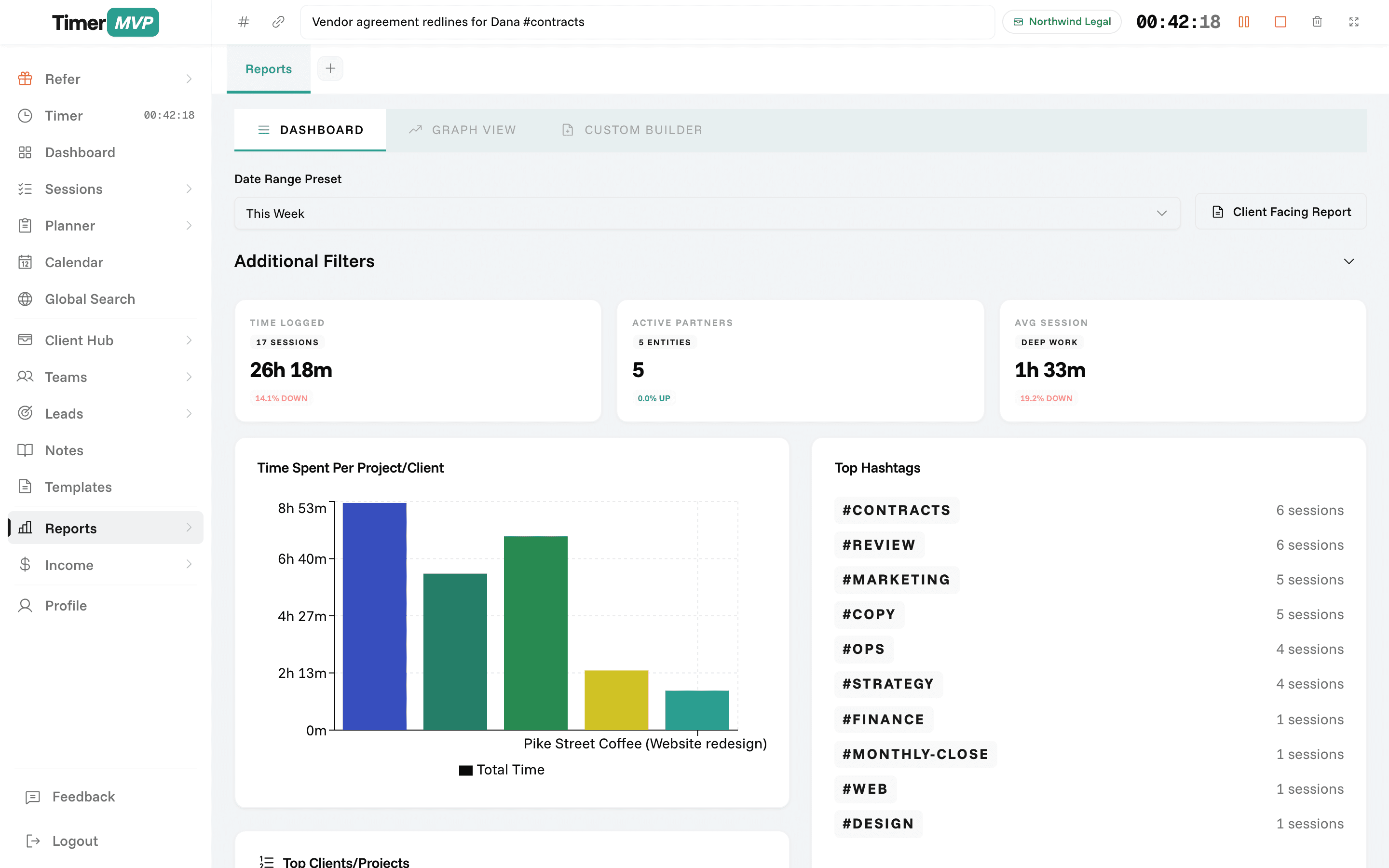
Then look for patterns. Did one client take more time than their fee supports? Did admin creep up? Did you spend time on a client that is not covered by any agreement? These are the questions that change how you price, scope, and schedule the next week. A report that groups hours by client and by week makes this a five-minute scan instead of a spreadsheet exercise.
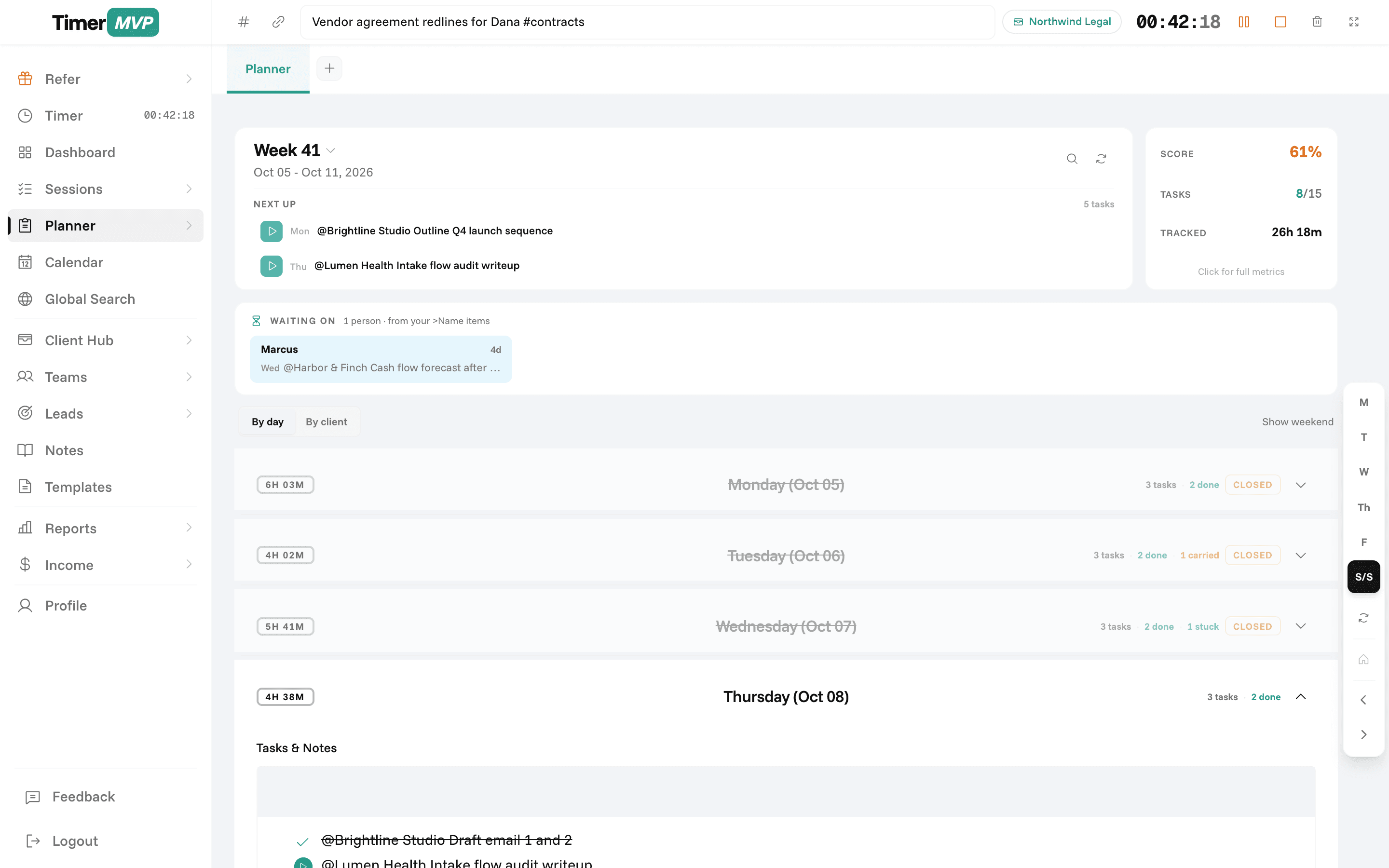
Close the review by noting one adjustment for next week. Maybe it is a scope conversation with a client, or blocking two mornings for deep work. The review only matters if it changes something. Write the adjustment where you will see it on Monday, so it becomes part of the next plan instead of a thought you had once on a Friday afternoon.
What are the most common billable hour tracking mistakes?
The biggest mistake is not tracking short tasks. People time the two-hour work block and skip the five-minute calls, the quick review, the follow-up email. Across a week those gaps can easily add up to several unbilled hours. The fix is a rule: if it is client work, it gets an entry, no matter how short. Once that rule is automatic, you stop deciding whether something is worth tracking, and the decision fatigue goes away with it.
The second mistake is leaving timers running. You start a timer, get pulled into something else, and come back to a four-hour entry that should have been forty minutes. Check running timers when you switch tasks and when you finish the day. Correct the entry immediately rather than guessing later. A quick look before you close your laptop catches most of these.
The third is mixing clients in one entry. A single block labeled two clients is impossible to bill cleanly. Split it at the time you switch. The fourth is waiting until invoice day to look at the data, when it is too late to fix anything without guessing. Every one of these mistakes is cheap to fix on the day it happens and expensive to fix a month later.
How do you turn tracked hours into an invoice?
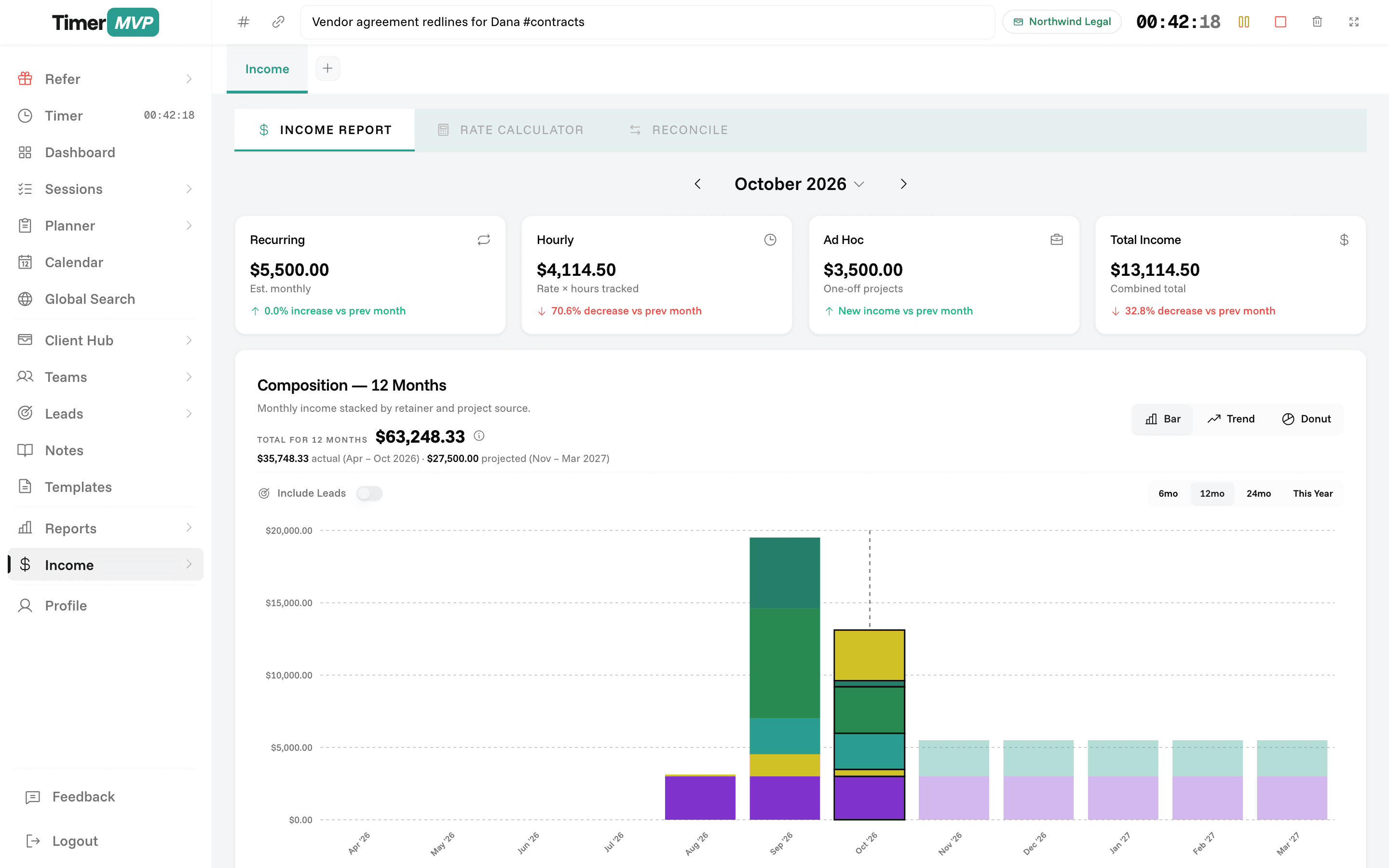
If your entries are clean, invoicing is assembly, not archaeology. Filter the period, group by client, apply your increment and rate, and review the notes once more for clarity. Convert minutes to decimal hours carefully. Forty-five minutes is 0.75 hours, not 0.45, and that mistake is more common than it should be. If you are adding up entries by hand, convert each one to decimal first, then total them, so the rounding happens once instead of compounding across every line.
Include enough detail for the client to understand the charge without overwhelming them. Many clients want a line per day or per task with a short description. Others prefer a total with a summary attached. Ask once and keep the format consistent. A predictable invoice is easier to approve, and easier approval means faster payment. Keep a copy of the underlying time report with each invoice. If a question comes up months later, you can answer it with the original record instead of a reconstruction.