Retainer vs Hourly: How to Know Which Clients Are Actually Worth It
Retainer or hourly? Compare the trade-offs, measure each retainer's effective rate, spot quiet clients and concentration risk, and learn when to renegotiate.
Retainers and hourly billing each have a reputation. Retainers are supposed to be stable and hourly is supposed to be fair. Both can be true, and both can hide problems. A retainer can feel like your best client while quietly paying less per hour than anyone else. Hourly work can feel unpredictable while actually being your most profitable. This guide compares the two, shows you how to measure what each client is really worth, and covers when it is time to change the terms.
In this guide
- 01What are the pros and cons of billing hourly?
- 02What are the pros and cons of a retainer?
- 03How do you measure a retainer's effective hourly rate?
- 04What should you do about quiet retainer clients?
- 05What is client concentration risk and how do you check it?
- 06When should you renegotiate a retainer?
- 07How do you decide which model is right for each client?
What are the pros and cons of billing hourly?
Hourly billing is simple to explain and directly connected to effort. If a client asks for more, they pay for more. Scope creep is less of a threat, because every extra request shows up on the invoice. It also gives you clean data, since you are already recording every hour to bill it. For new clients and loosely defined work, hourly is often the safest starting point for both sides.
The downsides are real too. Your income is capped by your hours, and it falls whenever you get faster at the work. Clients can feel anxious about open-ended costs, which leads to scrutiny of every line. Revenue swings from month to month with the client's needs, which makes planning harder. And some clients will hesitate to ask you for small things because they are watching the meter, which can weaken the relationship over time.
- Pros: fair to effort, scope creep is billed, simple to explain, clean data.
- Cons: income capped by hours, efficiency is not rewarded, revenue swings, clients watch the meter.
What are the pros and cons of a retainer?
A retainer is a recurring fee for ongoing access to your work, usually monthly. Its biggest benefit is predictability. You know what is coming in, which makes it easier to plan your week and your finances. Clients like it too, because their cost is known and they can ask for help without approving a new estimate each time. Good retainers often lead to deeper, longer relationships.
The risk is that the fee stays fixed while the work moves. A retainer scoped for a certain amount of work can slowly absorb more requests, longer meetings, and extra deliverables. Because the invoice never changes, nothing forces a conversation. Retainers also make it tempting to stop tracking time, since you are not billing by the hour. That is exactly when tracking matters most, because the hours are the only way to see whether the fee still fits.
- Pros: predictable income, easier planning, deeper relationships, clients ask freely.
- Cons: fixed fee with moving scope, drift is invisible without tracking, harder to renegotiate later.
How do you measure a retainer's effective hourly rate?
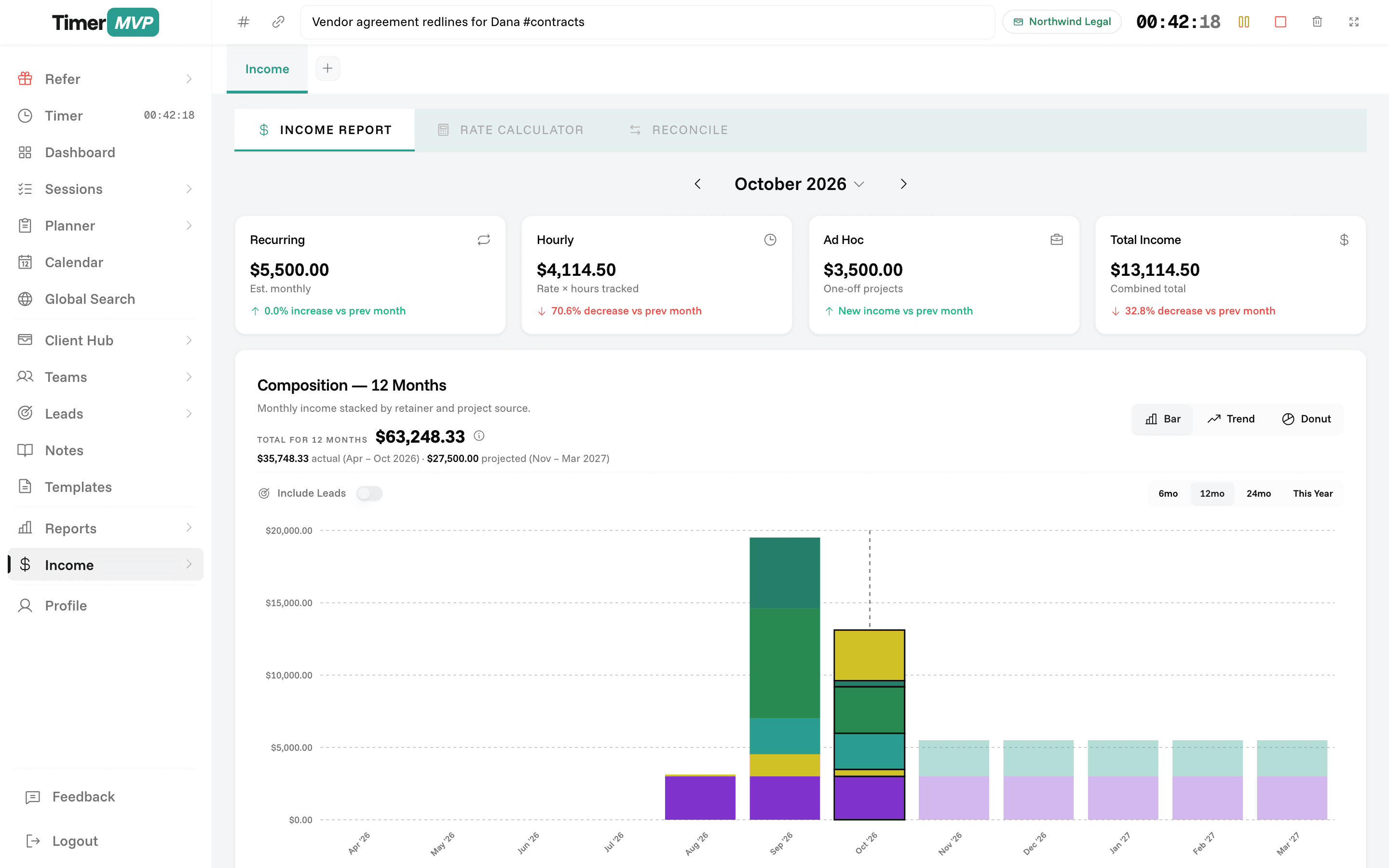
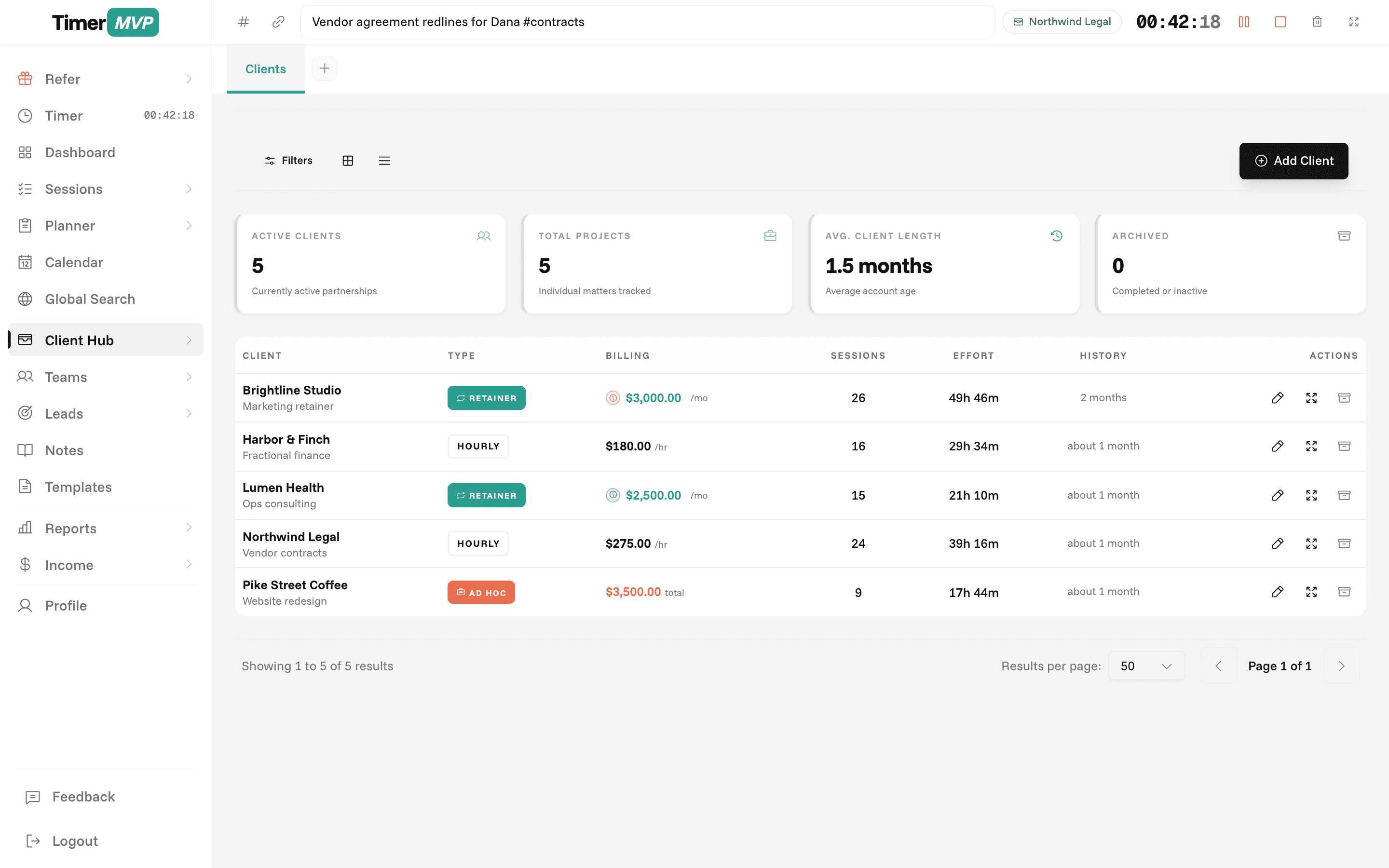
Track every hour you spend on the retainer client, including email, calls, and planning, exactly as you would for hourly work. At the end of each month, divide the retainer fee by those hours. The result is the effective hourly rate for that client. For example, a $2,500 monthly retainer that takes twenty hours works out to $125 an hour. If it takes thirty-five hours, it is about $71.
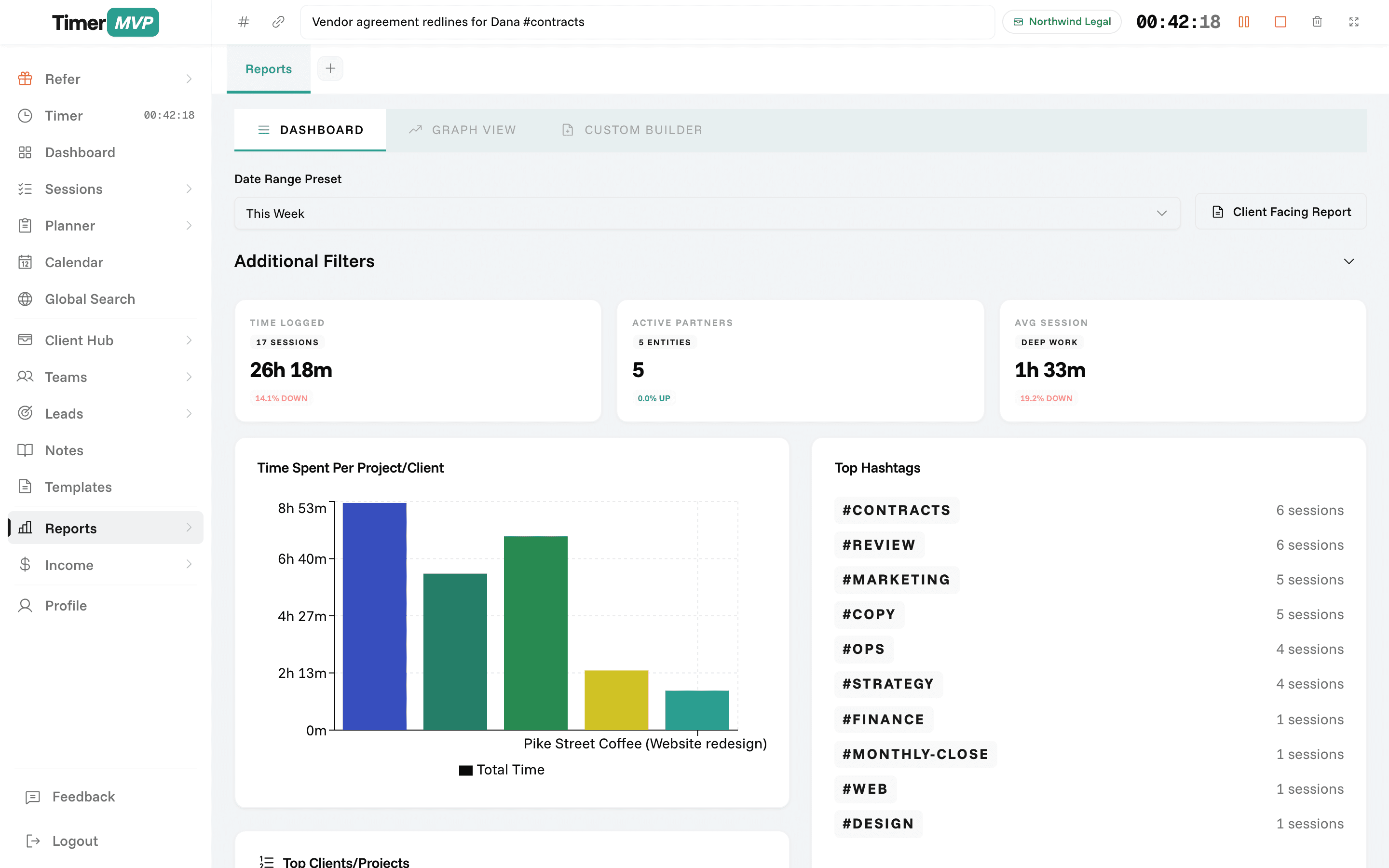
Compare that number with your hourly clients and with your target rate. Look at it over several months rather than one, because retainer work is often uneven. A heavy month followed by two light ones may average out fine. A steady climb in hours with a flat fee is the pattern to watch. TimerMVP shows earnings and hours per client side by side, which makes this comparison part of your normal reporting rather than a separate exercise.
If you include a set number of hours in the retainer, track usage against that allowance too. It gives you a factual basis for any future conversation about scope. If a client regularly uses more than the allowance, you can show them the pattern. If they regularly use less, you know the relationship may need attention, which is the next problem to look at.
What should you do about quiet retainer clients?
A quiet retainer client is one who pays every month but uses very little of your time. On paper this looks like your highest effective rate, and in the short term it is. But quiet clients are often at risk. If they are not getting much from you, they may start to wonder why they are paying, and the cancellation tends to arrive without warning.
Treat a quiet month as a prompt to reach out, not a windfall to ignore. Check in with something useful: a short summary of what you did, an idea for the next quarter, or a question about their priorities. The goal is to make the value of the retainer visible. Clients who see what they are getting are far more likely to keep paying for it.
Your time data helps here. A client whose hours have dropped steadily for two or three months is easy to spot in a report and easy to miss in day-to-day work. Seeing it early gives you time to re-engage before the relationship drifts. A falling line is not proof the client is unhappy. It is a reason to ask, and asking costs you very little compared with losing a steady monthly fee you had counted on.
What is client concentration risk and how do you check it?
Client concentration risk is the danger of depending too heavily on one or two clients. If a single client makes up a large share of your revenue, losing them is not a setback. It is a crisis. Retainers make this risk easy to fall into, because a big, steady client feels safe until the day they reorganize, change budgets, or bring the work in-house.
To check your exposure, list your clients by share of revenue over the last three to six months. Then do the same for share of hours. Look at the top name on each list and ask what would happen if that client left next month. If the honest answer is that you could not cover your costs, your concentration is too high, regardless of how good the relationship feels.
Reducing concentration takes time, so start before you need to. Keep some capacity for new clients, even when the big one would happily take it. Diversifying is easier from a position of stability than from a sudden gap. Even one or two smaller clients alongside a large one change the picture. They spread the risk, keep your sales skills in use, and give you somewhere to turn if the big client ever scales back.
- Rank clients by share of revenue and share of hours.
- Ask what happens if your top client leaves next month.
- Protect some capacity for new work even when you are busy.
When should you renegotiate a retainer?
Renegotiate when the numbers show the arrangement has drifted. The clearest signal is a sustained drop in effective rate, where hours have risen for several months without any change to the fee. Other signals include a scope that has grown to include work that was never discussed, or a market rate for your work that has moved well above what the retainer pays.
Bring data to the conversation. Show the client the hours spent over the last few months, what the retainer was originally designed to cover, and what has been added since. Most clients respond better to a factual summary than to a general request for more money. Offer options: a higher fee for the current scope, the same fee for a reduced scope, or a split where extra work is billed hourly.
Time the conversation well. The start of a new quarter, a contract renewal, or the launch of a new project are natural moments. Raising it in the middle of a deadline rarely goes well. Give the client notice, usually a month or more, so they can plan around the change. Framing it as a review of the arrangement, rather than a demand, keeps the conversation focused on the work instead of the relationship.
How do you decide which model is right for each client?
There is no single right answer for your whole business. Many independent professionals use both. Hourly tends to fit new clients, unclear scopes, and work that comes in bursts. Retainers tend to fit established relationships with predictable, ongoing needs. You can also start a client on hourly and move them to a retainer once you have a few months of data showing what the work actually takes.
Whatever you choose, measure it the same way. Track every hour, calculate the effective rate per client each month, and review the list regularly. The model is just a pricing structure. The hours and the effective rate tell you whether that structure is working, and they give you the evidence you need to change it when it is not. Review the mix every quarter.